The three bones
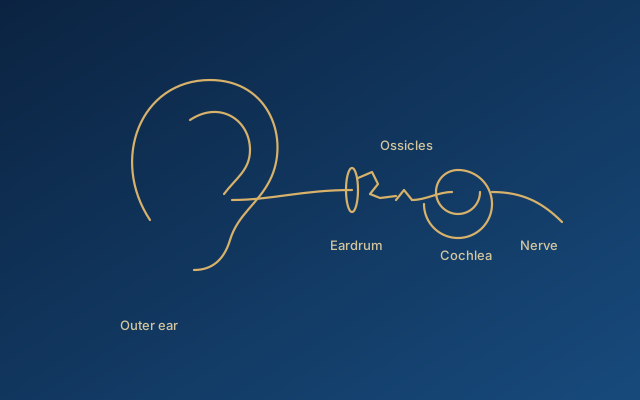
The malleus is fixed to the eardrum and rotates with it. The incus hangs between malleus and stapes; its long process is thin and poorly supplied with blood, which is why it is the first to erode in chronic disease. The stapes delivers the vibration to the inner ear through its footplate. A gap anywhere along this line — most often at the incudostapedial joint — produces a conductive loss of up to 50–60 dB.
What reconstruction does
Ossiculoplasty rebuilds a bridge between whatever remains at the eardrum end and whatever remains at the inner-ear end. Options, roughly in order of preference when available:
- Repositioned or reshaped autograft — the person’s own incus or malleus head, sculpted to fit; no foreign material, no extrusion.
- Partial ossicular replacement prosthesis (PORP) — connects the eardrum or malleus to an intact stapes superstructure.
- Total ossicular replacement prosthesis (TORP) — connects to the stapes footplate when the superstructure is gone.
Prostheses are made of titanium, hydroxyapatite or other biocompatible materials; a small disc of cartilage is usually placed between prosthesis and eardrum to prevent extrusion.
What determines the result
The single most favourable finding is an intact, mobile stapes. Reconstruction onto the superstructure is more stable and gives better and more durable hearing than reconstruction onto the footplate. Beyond that: a dry, well-ventilated middle ear, a healthy or well-repaired drum, absence of active cholesteatoma, and a mobile malleus. Prognostic scores exist and are useful for setting expectations.
Expectations by situation
Reported closure of the air-bone gap to ≤20 dB is around 70–80% for PORP-type reconstructions with a present stapes and a normal middle ear, falling to 50–60% for TORP reconstructions and lower again in ears with poor ventilation, extensive tympanosclerosis or revision. The Middle Ear Risk Index (MERI) and OOPS index stratify these expectations. Results deteriorate slowly over years in a proportion of ears through displacement, extrusion or re-fixation; long-term data beyond ten years are limited. Staging — closing the ear first and reconstructing once it is proven clean and dry — remains reasonable in cholesteatoma and wet ears.
Hearing objective and limitations
A reconstructed chain is never as efficient as the original. A residual gap of 10–20 dB is common and often acceptable. The result is measured on the audiogram at three to six months, but the more useful question is whether hearing in daily life has changed and whether a device is still needed. In a proportion of ears — particularly TORP reconstructions and revision cases — the honest answer before surgery is that a hearing aid may still be the best route to good hearing, and reconstruction serves mainly to make the ear easier to aid.
Hearing preservation
The reconstruction sits on or in the oval window. Disturbing the footplate risks the inner ear, and reconstruction in an only-hearing ear is approached with great caution. Bone-conduction thresholds before and after are the marker of whether the inner ear was protected.
Revision
Failed reconstructions are common enough that any ossiculoplasty should be planned with a possible second attempt in mind. Revision ear surgery sets out how to think about a result that did not last.
The surgical decision
Seven questions every recommendation should answer
-
Problem
What is wrong?
Conductive hearing loss from erosion, fixation or discontinuity of the malleus, incus or stapes, usually after chronic infection, cholesteatoma or trauma.
-
Objective
What are we trying to achieve?
Re-establish a stable, mobile connection between the eardrum and the inner ear.
-
Expected benefit
What may improve?
Air-bone gap within 20 dB in roughly 60–75% of ears overall; better when the stapes superstructure is present and the ear is dry and well ventilated.
-
Alternatives
What other options exist?
A hearing aid, often excellent in a closed dry ear; a bone-conduction device; observation.
-
Preservation
What existing hearing must be protected?
Inner-ear function, the facial nerve, the stapes footplate, and a reconstruction that can be revised if it fails.
-
Risk
What are the relevant trade-offs?
Prosthesis extrusion or displacement, no improvement, rarely worse hearing, dizziness if the footplate is disturbed, need for revision.
-
Personal priorities
What matters to this individual?
Whether the person wants to try for device-free hearing in an ear that may need more than one operation, or prefers the predictability of a device.
This page provides general educational information. It cannot replace an individual assessment, which depends on a full history, examination, audiometry and, where relevant, imaging. If you have sudden hearing loss, severe pain, facial weakness, severe dizziness or discharge with fever, seek medical care promptly.