
What the operation does
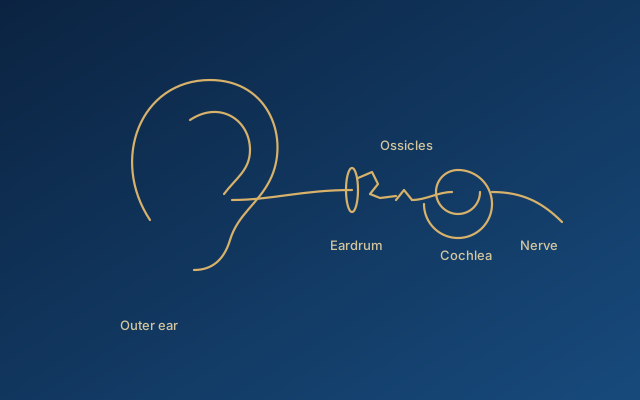
Tympanoplasty repairs the eardrum and, when necessary, inspects and treats what lies behind it. A graft — most often a piece of the person’s own fascia (the sheath of the temporalis muscle) or cartilage with its perichondrium from the ear — is placed under or over the remaining drum, where it serves as a scaffold for new membrane to grow across. Over weeks the graft is incorporated into a new, slightly thicker eardrum.
The approach is through the ear canal, with an endoscope or microscope, or through a small incision behind or in front of the ear when access requires it.
Infection control
A closed drum stops water and bacteria entering the middle ear and ends the cycle of discharge in most mucosal disease. This alone is a good reason for surgery in a person who has stopped swimming, uses drops repeatedly, or cannot wear a hearing aid because the ear is wet. If the ear is actively infected, it is usually treated first; a dry ear at the time of surgery improves the chance of the graft taking.
Hearing
Closing the drum restores the collecting surface and re-establishes the pressure difference across it. If the ossicles are intact and mobile and the middle ear is healthy, hearing improves substantially. If the incus is eroded or the chain is fixed by scar, closing the drum alone leaves a gap; the surgeon will then either reconstruct the chain at the same time or plan a second stage. Ventilation matters too: an ear that cannot equalise pressure may retract again, and a stiffer cartilage graft is often chosen for that reason.
A safe ear and a better-hearing ear
These are two objectives. The first — a closed, dry ear — is achieved in most operations. The second depends on the middle ear and cannot be guaranteed by the repair itself. It is worth hearing both expectations stated separately before surgery, in numbers where possible: what is the chance the ear is closed at six months, and what hearing is realistically expected?
Graft choice and technique
Temporalis fascia remains the reference for uncomplicated central perforations. Cartilage (palisade, island or full-thickness) has higher take rates in large, anterior, subtotal and revision perforations and in poorly ventilated ears, with hearing results comparable to fascia in meta-analyses. Underlay is standard; overlay or lateral grafting is used for anterior and total perforations at the cost of blunting and lateralisation risk. Endoscopic transcanal tympanoplasty avoids a postauricular incision with equivalent take rates for most perforations. Ossicular status should be assessed at every tympanoplasty; a type I repair with an unrecognised fixed malleus produces a closed ear with disappointing hearing.
Recovery and expectations
Packing in the canal and a blocked feeling last one to three weeks. The graft is assessed at around six weeks; hearing is judged at three months, once the middle ear has cleared. Water must be kept out until the surgeon confirms the drum is closed. Re-perforation can occur early from infection or late from poor ventilation, and a second repair is sometimes needed.
For most people the outcome is an ear that can be forgotten about — which, in chronic ear disease, is the point.
The surgical decision
Seven questions every recommendation should answer
-
Problem
What is wrong?
A persistent eardrum perforation, with or without discharge, ossicular damage or retraction, causing infection risk, water restriction and conductive hearing loss.
-
Objective
What are we trying to achieve?
First, a closed, dry, safe ear. Second, where the middle ear allows, better sound transmission.
-
Expected benefit
What may improve?
Graft take in roughly 85–95%; hearing gain that depends on the state of the ossicles and middle ear, often 10–20 dB when the chain is intact.
-
Alternatives
What other options exist?
Living with a dry perforation and keeping water out; a hearing aid; treating infection medically and deferring surgery.
-
Preservation
What existing hearing must be protected?
Inner-ear hearing, the facial nerve, the chorda tympani, and the ability to wear a hearing aid comfortably afterwards.
-
Risk
What are the relevant trade-offs?
Graft failure or re-perforation, no hearing improvement, rarely worse hearing, temporary taste change, dizziness, infection.
-
Personal priorities
What matters to this individual?
Swimming and water, freedom from discharge and drops, hearing at work or with family, how much surgery the person is prepared to accept.
This page provides general educational information. It cannot replace an individual assessment, which depends on a full history, examination, audiometry and, where relevant, imaging. If you have sudden hearing loss, severe pain, facial weakness, severe dizziness or discharge with fever, seek medical care promptly.