
The chain
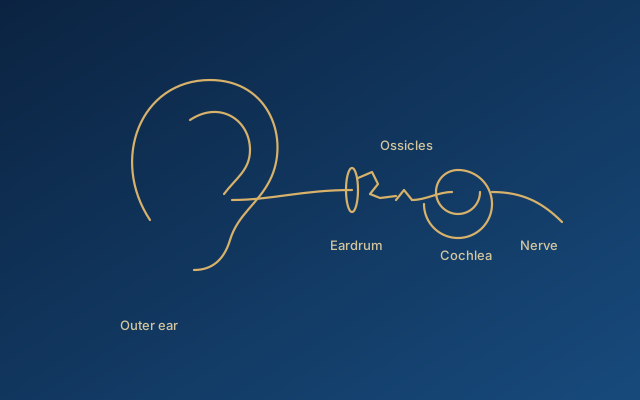
The malleus is attached to the eardrum. The incus links it to the stapes, whose footplate sits in the oval window of the inner ear. Together they act as a lever and a piston, delivering the vibration of a large membrane to a small opening. The chain is suspended by ligaments and tendons, and the joint between the incus and stapes — the thinnest link — is the part most often damaged.
Three ways it fails
Fixation. A bone that cannot move. The classic cause is otosclerosis fixing the stapes, but the malleus can be fixed in the attic by bony bridges (congenital or after inflammation), and any ossicle can be trapped in the chalky plaques of tympanosclerosis after long-standing infection.
Erosion. Bone worn away by disease. The long process of the incus has a poor blood supply and is the first casualty of chronic infection, cholesteatoma or a retraction pocket; the stapes superstructure is next.
Discontinuity. A chain that has come apart. Trauma to the head can dislocate the incus; a fracture can separate the stapes. A partial discontinuity held together by fibrous tissue behaves oddly on the audiogram — a large low-frequency gap with better hearing at high frequencies.
Congenital malformations of the chain also occur, sometimes with an abnormal facial nerve or a missing oval window, and need careful imaging before any surgery.
Recognising the pattern
An air-bone gap with a normal eardrum and no otosclerosis history points to the chain. Tympanometry helps: a very compliant, “floppy” tympanogram suggests discontinuity; a stiff one suggests fixation. The stapedial reflex is absent in both. High-resolution CT can show a missing incus long process, a dislocated joint or a fixed malleus head, but small lesions are easily missed, and the definitive answer often comes only when the middle ear is inspected.
Audiometric clues to the site of the lesion
Complete discontinuity produces a maximal conductive loss (50–60 dB gap) with a flat or rising configuration and a Type Ad tympanogram. Malleus fixation gives a gap that is often larger at low frequencies with a normal or As tympanogram, and may coexist with stapes fixation — a reason for poor results after stapedotomy alone. Isolated incudostapedial erosion with a fibrous union classically shows a gap that narrows towards the high frequencies. None of these patterns is specific enough to replace inspection; they are hypotheses to test, not diagnoses.
Treatment
The options mirror those for any conductive loss: observation, a hearing aid, or reconstruction. Ossiculoplasty rebuilds the chain with the person’s own reshaped bone or cartilage, or with a prosthesis. Results depend heavily on what remains: a mobile stapes with an intact superstructure is the single most favourable finding, and an ear that is dry and well ventilated does better than one that is not.
Because the chain sits a millimetre from the inner ear and the facial nerve, the same principle applies as elsewhere on this site: know what is wrong before deciding how to fix it, and be clear about what must be protected while doing so.
This page provides general educational information. It cannot replace an individual assessment, which depends on a full history, examination, audiometry and, where relevant, imaging. If you have sudden hearing loss, severe pain, facial weakness, severe dizziness or discharge with fever, seek medical care promptly.