
Why the eardrum perforates
The eardrum is a three-layered membrane about a tenth of a millimetre thick. It perforates for a limited number of reasons:
- Infection. An acute middle-ear infection builds pressure until the drum gives way; the discharge that follows brings relief. Most of these perforations heal within weeks.
- Chronic infection. A perforation that never closed, or a drum weakened by repeated infections, can leave a persistent hole with intermittent discharge.
- Trauma. A slap on the ear, a cotton bud, a blast, or a rapid pressure change while diving or flying.
- Ventilation tubes. A small proportion of tubes leave a hole after they fall out, more often after long-term tubes.
What a hole does to hearing
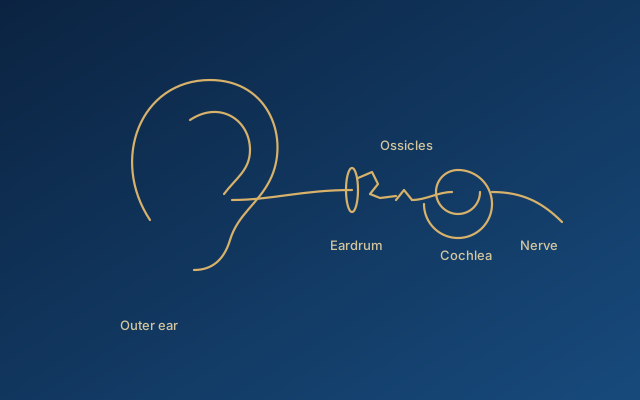
The eardrum collects sound over its whole surface and concentrates it onto the tiny footplate of the stapes; together with the lever action of the ossicles, this gives roughly 25–30 dB of mechanical gain. A perforation loses part of that surface and lets sound reach both sides of the drum at once, cancelling some of its movement. The hearing loss is usually mild to moderate — 10 to 30 dB — and depends more on the size of the hole than its position, though a large or posterior perforation can also expose the ossicles to damage.
If the loss is greater than the hole would explain, something else is likely also wrong: an eroded incus, a fixed malleus, fluid or scar tissue behind the drum. This is why a hearing test before repair is essential, and why the expected result must be discussed in terms of both a closed ear and hearing.
Will it heal by itself?
Most traumatic and acute-infection perforations heal within six to twelve weeks. Healing is less likely when the hole is large, when the edges have healed over as skin, when infection keeps recurring, or when the Eustachian tube does not ventilate the ear well. A perforation that is still open after three to six months is unlikely to close without help.
While the drum is open, keep water out of the ear (a cotton-wool ball with petroleum jelly, or a fitted plug, for washing and swimming) and avoid blowing the nose forcefully.
When to consider repair
Repair — tympanoplasty — is reasonable when a perforation:
- keeps discharging or causes repeated infections;
- prevents swimming or normal daily life;
- causes a hearing loss that matters to the person;
- needs closing to allow a hearing aid to be fitted comfortably;
- is associated with disease that needs exploring, such as cholesteatoma.
It is equally reasonable to leave a small, dry, asymptomatic perforation alone, especially in an ear that is the only hearing ear or in someone who would rather not have surgery.
Prognostic factors for graft take and hearing
Graft take rates in most series are 85–95% with temporalis fascia and slightly higher with cartilage, particularly in high-risk ears (large or anterior perforations, revision cases, poor Eustachian-tube function, smokers). Cartilage grafts have not been shown to worsen hearing results in meta-analyses despite their stiffness. Hearing outcome is governed mainly by ossicular status and middle-ear mucosa rather than by graft material. A dry ear at the time of surgery improves take; active discharge should be treated first where possible.
After repair
The practical version of this page for the Colombiers practice, with the same message about cotton buds and healing, is at grolman-orl.fr/perforated-eardrum.
A successful repair gives a closed, dry ear that can get wet again. Hearing improves in most people, but not always to normal: the middle ear may have other problems, and a reconstructed drum is never quite the original. A safe, dry ear and a better-hearing ear are related goals that should each be discussed on their own terms.
This page provides general educational information. It cannot replace an individual assessment, which depends on a full history, examination, audiometry and, where relevant, imaging. If you have sudden hearing loss, severe pain, facial weakness, severe dizziness or discharge with fever, seek medical care promptly.